Akrid Designs - AD portfolio
Akrid Designs from pencil to pixel
Overall I wanted the Akrid on this prequel to Lost Planet 1 to have several guiding principals
1. All Akrid detect prey by heat, and any heat signature the same size or smaller was fair game. They would actively avoid much larger heat signatures. As such they didn't necessarily need eyes. I followed a very Barlowe-esque series of rules, where the environment dictated the evolutionary traits.
2. The Akrid were highly adaptable to their environment. I thought up the idea that the Akrid have Hyperadaptive genetics, and that all Akrid came from a single type of larvae, that could mutate based on environmental or hormonal queues. Similar to how queen bees come from the same larvae as regular bees. The DNA contained in the larvae would be extremely complex, imagining many more sequences than any other living organism. This served to allow us to make the Akrid crustacean, insectoid, or mammaloid as we needed. It also helped to explain how the Akrid could survive the terraforming (read warming) of EDN III from Lost Planet 1 to 2.
3. All Akrid had to have the same glowing orange thermal energy weak points that were shown in Lost Planet 1. I didn't have it bound to the same locations, but told the artists to use both game-logical and aesthetically pleasing locations.
4. I used a methodology of wide-deep-final for all concepts, which made honing in on a design a lot easier and more enjoyable for the artists, while increasing predictability for production.
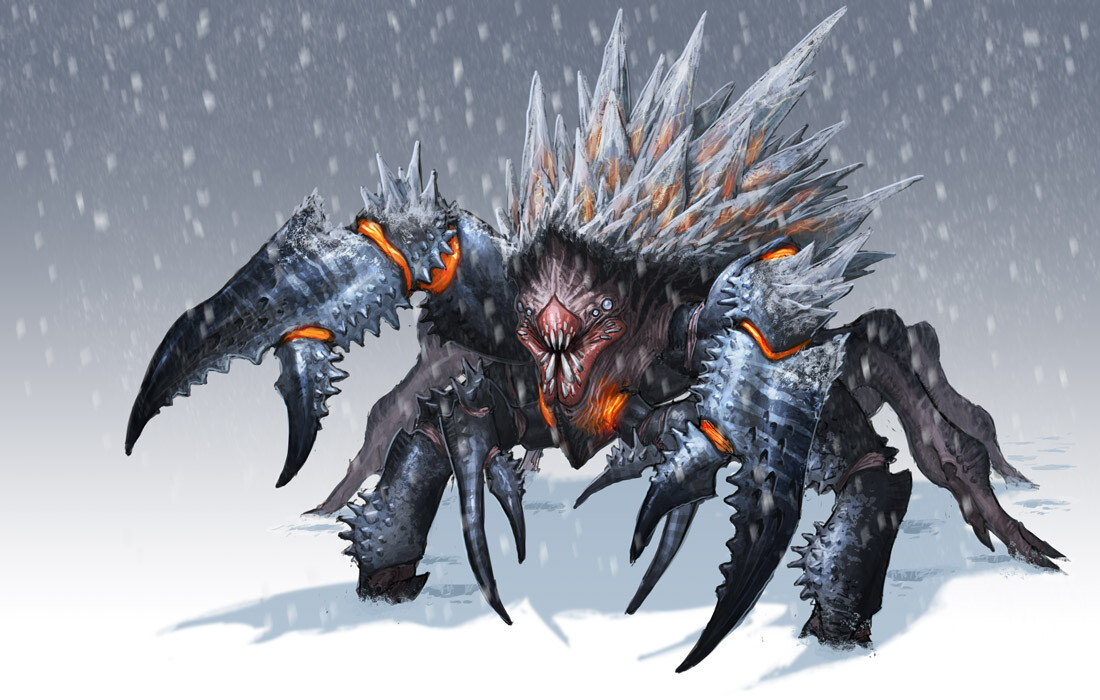
Initial Disign for Ice Crab. It's a gigantic ambush predator that hides among the spiky ice plains. It's back of hard ice protects a vital weak spot. This can be destroyed either with munitions fire or the Vital Suit destroying it.

Turnarounds for Ice Crab showing construction, weak points, and general color. A callout to the center body was made to aid the 3D sculptor

This is a material callout sheet. I had every concept use this to show intended texture of various parts of the concept. This was to aid the sculptor to better understand how a material should look and behave.

This is a vital area callout to aid in understanding destructible points. Animation and Engineering supported this with detachable joints at this area. Sculptors had to make the claws and 'biceps' water tight so when they broke off they looked whole.

This was the first design for ice crab. Note the lack of orange vital weak spots.

The Ice Crab as built in Unreal. Very proud of the team and how we were able to realize this as a fun and terrifying enemy. Specularity was raised to near metalness levels for the eyes to get that beady, shark like look.
King of the Hill test animation footage courtesy of Blur Studios. They really loved the design of the Ice Crab and had fun with the creature. It felt really good to connect with Tim Miller and his crew, knowing they responded to our designs positively